White fused alumina is a high-purity abrasive material widely used for surface preparation, grinding, polishing, refractory products, and precision finishing. One of the most important factors when selecting white fused alumina is grit size.
Different grit sizes produce different cutting, grinding, cleaning, and finishing effects. Coarser grains are generally selected when high material removal and aggressive surface treatment are required, while finer grains are more suitable for precision grinding, polishing, and finishing.
Understanding the relationship between white fused alumina grit sizes and applications can help manufacturers and abrasive users select the right material for their specific processes.
What Is White Fused Alumina?
White fused alumina is produced by melting high-purity alumina in an electric arc furnace and then cooling, crushing, and grading the material into different particle sizes.
It is known for its:
- High Al₂O₃ content
- High hardness
- Low magnetic impurity content
- Sharp and angular grain shape
- Good chemical stability
- Excellent thermal resistance
- Consistent abrasive performance
Because of these properties, white fused alumina is commonly used in bonded abrasives, coated abrasives, blasting, refractory materials, ceramics, and precision surface treatment.
How Does White Fused Alumina Grit Size Affect Performance?
The grit size determines the approximate particle size of the abrasive material.
In general:
Coarse grit → higher material removal → rougher surface
Fine grit → lower material removal → smoother surface
However, grit size should not be selected by particle size alone. The ideal grade also depends on the workpiece material, equipment, operating conditions, required surface finish, and abrasive process.
For example, a coarse white fused alumina grain may be suitable for removing heavy surface contamination, while a fine powder may be preferred for precision polishing.
White Fused Alumina Grit Sizes and Typical Applications
Different standards may use different grading systems, including FEPA, JIS, ANSI, and other customer-specific specifications. Therefore, buyers should always confirm the exact grading standard before ordering.
The following table provides a general guide.
| Grit Range | General Characteristics | Typical Applications |
|---|---|---|
| Coarse Grit | High cutting and material removal | Blasting, surface preparation, refractory |
| Medium Grit | Balanced cutting performance | Grinding wheels, surface treatment |
| Fine Grit | Smoother cutting action | Precision grinding, finishing |
| Micro Powder | Very fine particles | Polishing, ceramics, precision finishing |
1. Coarse White Fused Alumina Grit
Coarse white fused alumina grains are commonly selected when fast material removal and aggressive surface treatment are required.
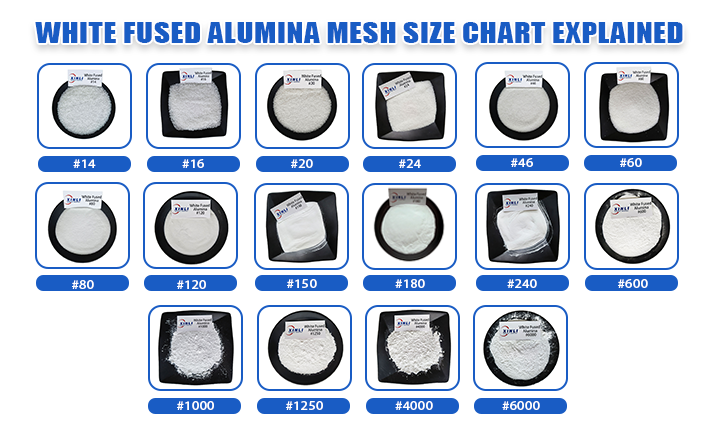
Typical coarse grades include larger grit sizes such as 8, 10, 12, 14, 16, 20 and 24, depending on the applicable grading standard.
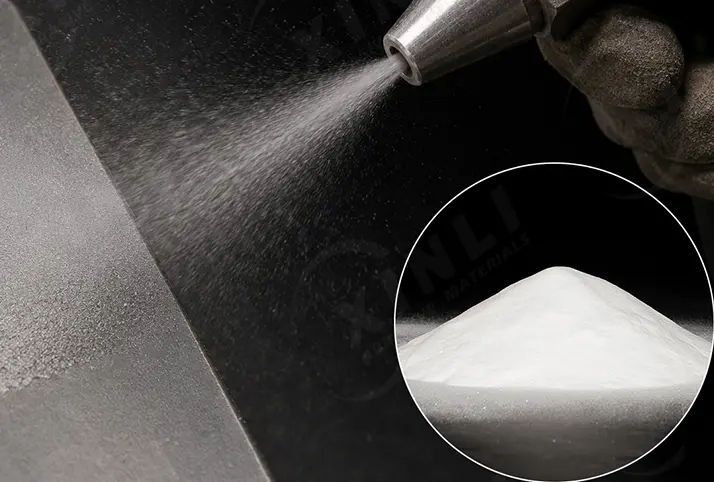
Abrasive Blasting
Coarse white fused alumina can be used for blasting applications where the objective is to remove:
- Oxide layers
- Surface contamination
- Coatings
- Rust
- Residues
- Previous surface treatments
Because white fused alumina is a high-purity abrasive, it can be suitable for applications where contamination from the abrasive needs to be minimized.
Refractory Materials
Coarser white fused alumina grains are also used as aggregate in refractory products.
The high temperature resistance and chemical stability of alumina make it suitable for refractory applications such as:
- Shaped refractories
- Monolithic refractories
- Furnace linings
- Ceramic components
Anti-Slip and Surface Treatment
Selected coarse grains can also be incorporated into industrial surfaces where increased surface roughness or wear resistance is required.
2. Medium White Fused Alumina Grit
Medium grit provides a balance between cutting efficiency and surface finish.
Common grades in this range may include approximately 24, 30, 36, 46, 54 and 60, depending on the grading system.
Grinding Wheels
White fused alumina is widely used in vitrified and resin-bonded grinding wheels.
Medium grit can provide an appropriate balance between:
Cutting ability + grinding efficiency + surface finish
It can be used for grinding various hard materials and components where controlled material removal is required.
Coated Abrasives
Medium white fused alumina grains can also be used in:
- Abrasive belts
- Abrasive discs
- Sandpaper
- Abrasive rolls
- Other coated abrasive products
The angular grain structure provides effective cutting action during grinding and surface preparation.
Surface Finishing
Medium grades can also be selected for applications that require more controlled surface preparation than coarse blasting.
3. Fine White Fused Alumina Grit
Fine white fused alumina is used when the application requires better surface control and a smoother finish.
Typical fine grades can include 80, 100, 120, 150, 180 and finer grades, depending on the required specification.
Precision Grinding
Fine grains can be used for precision grinding where excessive material removal is undesirable.
They can help manufacturers achieve:
- Better dimensional control
- More uniform surfaces
- Reduced surface roughness
- Consistent finishing results
Polishing
Fine white fused alumina is also used in polishing processes where a smoother surface is required.
The appropriate grain size depends on the material being polished and the required final surface finish.
Ceramic Processing
Fine alumina abrasive materials can also be used in ceramic processing and finishing applications where controlled particle size is important.
4. White Fused Alumina Micro Powder
White fused alumina micro powder represents the finer end of the particle-size range.
These very fine particles are commonly used for applications requiring precise surface treatment rather than aggressive material removal.
Typical applications include:
- Precision polishing
- Fine grinding
- Ceramic processing
- Surface finishing
- Specialized abrasive products
For micro powder applications, particle-size distribution and consistency are particularly important.
Depending on the customer’s requirements, specifications may be based on standards such as FEPA or JIS, or on a customized particle-size distribution.
How to Choose the Right White Fused Alumina Grit Size?
Choosing a white fused alumina grit should start with the purpose of the abrasive process.
For aggressive material removal
Choose a coarser grit.
Suitable for:
- Heavy surface preparation
- Blasting
- Removing coatings
- Rough grinding
- Refractory aggregate
For general grinding
Choose a medium grit.
Suitable for:
- Grinding wheels
- Abrasive discs
- Abrasive belts
- General surface treatment
For fine finishing
Choose a fine grit.
Suitable for:
- Precision grinding
- Fine surface treatment
- Finishing
- Polishing
For precision polishing
Choose fine powder or micro powder.
Suitable for:
- Precision polishing
- Ceramic finishing
- Fine grinding
- Specialized surface treatment
White Fused Alumina Grit Size Selection Guide
A simple way to understand the selection process is:
Coarse → Remove → Medium → Grind → Fine → Finish → Micro → Polish
However, there is no single grit size that is suitable for every application.
The optimal grade depends on several factors:
1. Workpiece Material
Different materials require different abrasive characteristics.
For example, abrasive selection for stainless steel, ceramics, glass, or refractory materials may vary significantly.
2. Required Surface Finish
If a rough surface is acceptable, a coarser grain may be more efficient.
If a smooth surface is required, a finer grain is generally more appropriate.
3. Material Removal Rate
Applications requiring rapid material removal generally benefit from larger abrasive grains.
Precision applications usually require finer particles and more controlled cutting action.
4. Abrasive Equipment
The abrasive system also affects grit selection.
Grinding wheels, blasting equipment, abrasive belts, and polishing systems can require different grain specifications.
5. Grading Standard
Always confirm whether the customer requires:
- FEPA
- JIS
- ANSI
- Customized particle size
The same nominal grit number should not automatically be assumed to have identical particle-size characteristics across different standards.
White Fused Alumina Grits for Different Applications
For industrial buyers, the following simplified guide can be used as a starting point:
| Application | Recommended Direction |
|---|---|
| Heavy-duty blasting | Coarse grit |
| Surface preparation | Coarse to medium grit |
| Grinding wheels | Medium to fine grit |
| Abrasive belts | Medium to fine grit |
| Precision grinding | Fine grit |
| Polishing | Fine grit / micro powder |
| Ceramic finishing | Fine grit / micro powder |
| Refractory products | Coarse to medium grain |
| Fine surface finishing | Fine grit |
The exact grade should be determined according to the equipment, workpiece, required finish, and customer’s technical specification.
Why Choose High-Quality White Fused Alumina?
For industrial abrasive applications, consistent grain quality is just as important as grit size.
A reliable white fused alumina supplier should provide consistent:
- Chemical composition
- Grain size
- Particle-size distribution
- Grain shape
- Cleanliness
- Packaging
- Batch-to-batch performance
Consistent grading is especially important for abrasive manufacturers because variations in particle size can affect grinding efficiency, surface finish, abrasive consumption, and production stability.
Conclusion
White fused alumina is available in a wide range of grit sizes, from coarse grains for aggressive surface treatment to fine powders for precision grinding and polishing.
Choosing the correct white fused alumina grit size depends primarily on the application, workpiece material, required material removal rate, surface finish, equipment, and grading standard.
As a general rule:
Coarse grains are suitable for material removal and surface preparation, medium grains for grinding, fine grains for finishing, and micro powders for precision polishing.
For industrial applications, the best solution is not simply to choose the finest or coarsest abrasive, but to select the appropriate grain size for the specific process.
If you need a specific white fused alumina grit, particle-size distribution, or packaging specification, contact the supplier with your application requirements so the appropriate grade can be recommended.