Why Ceramic Membrane Manufacturers Use Ultra Low Sodium WFA
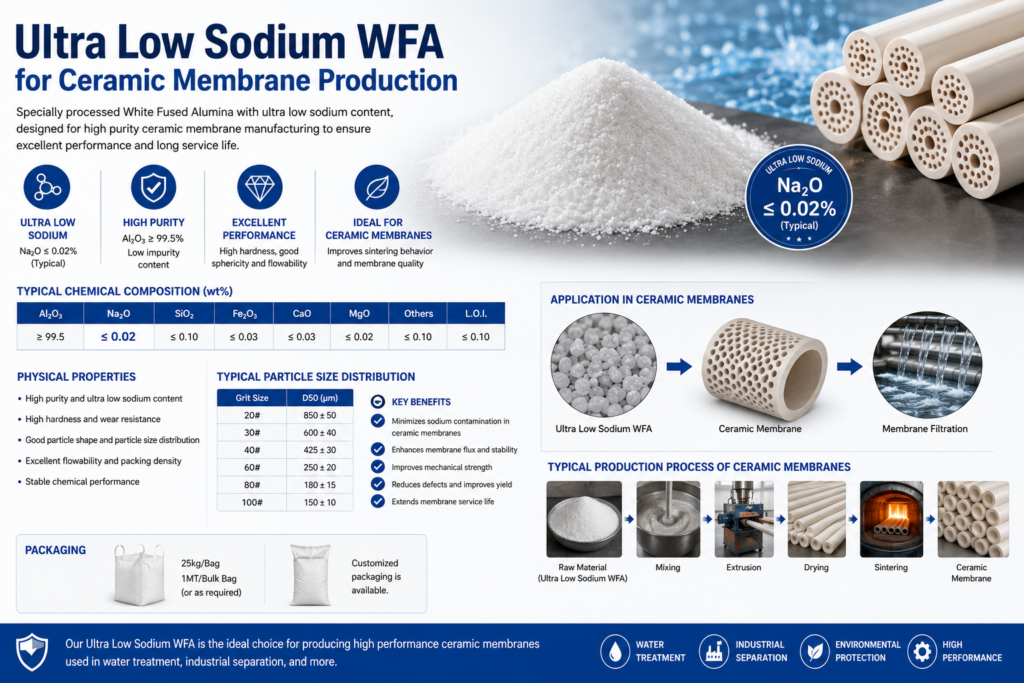
Ultra low sodium WFA, also called ultra low sodium white fused alumina, is increasingly used in ceramic membrane production because ceramic membrane products require stable porosity, high temperature resistance, chemical stability, and controlled impurities.
Ceramic membranes are not ordinary abrasive applications. The raw material is not selected only by hardness or whiteness. For membrane supports, porous ceramic tubes, flat sheet membranes, and ceramic filtration elements, the particle size distribution and sodium oxide content can directly affect sintering behavior, pore structure, mechanical strength, and final filtration performance.
That is why many ceramic membrane manufacturers prefer low sodium or ultra low sodium white fused alumina instead of standard WFA.
What Is Ultra Low Sodium WFA?
Ultra low sodium WFA is a high-purity fused alumina material produced from alumina powder by electric arc furnace melting. After cooling, crushing, magnetic separation, and screening, it can be supplied as grain, fine powder, or custom graded powder.
The key difference is the controlled Na2O content.
For ceramic membrane applications, buyers often care about:
| Item | Why It Matters |
| Low Na2O | Reduces unwanted glass phase and sintering instability |
| High Al2O3 | Supports chemical and thermal stability |
| Stable particle size | Helps control pore size and permeability |
| Low Fe2O3 | Reduces contamination and color change |
| Clean grading | Improves repeatability between batches |
Typical low sodium requirements may be Na2O ≤0.10%, while stricter ceramic membrane projects may request Na2O ≤0.05%. The final value should be confirmed according to the buyer’s formula and firing process.
Where WFA Is Used in Ceramic Membrane Products
In ceramic membrane production, ultra low sodium WFA is mainly used for the porous ceramic structure, especially the support body or base layer.
A ceramic membrane usually includes:
| Layer / Part | Function | Material Requirement |
| Support body | Provides mechanical strength and fluid channel | Stable coarse and medium particles |
| Transition layer | Connects support and separation layer | Finer controlled powder |
| Separation layer | Controls filtration precision | Very fine ceramic powder system |
Ultra low sodium WFA is commonly selected for the support body and sometimes for the transition layer, depending on the membrane design.
For the support body, the material must form a strong but porous structure after sintering. If the particle size is too fine, the pores may become too small and filtration resistance may increase. If the particles are too coarse or poorly distributed, the membrane body may have weak points, uneven pores, or unstable pressure resistance.
Why Low Sodium Content Is Important
Sodium oxide can act as a flux during high-temperature firing. In some ceramic products, this may help sintering, but in ceramic membrane production it can create problems if not controlled.
High sodium content may cause:
- Excessive liquid phase during sintering
- Unstable shrinkage
- Partial pore blockage
- Reduced porosity
- Lower chemical resistance
- Batch-to-batch variation
- Changes in membrane strength and permeability
For ceramic membranes, the goal is not simply to make the ceramic body dense. The product must maintain a controlled porous structure. This is why ultra low sodium WFA is valuable: it helps manufacturers keep the ceramic body more stable during firing and improves consistency in mass production.
Particle Size Selection for Ceramic Membrane Supports
Particle size selection depends on the membrane structure, target pore size, forming method, and firing temperature. The following table can be used as a practical reference for buyers and engineers.
| WFA Size Range | Typical Role in Ceramic Membrane | Notes |
| F24-F46 | Coarse support structure | Used when higher permeability and larger pores are required |
| F60-F100 | Main support body material | Common for porous ceramic support balance between strength and flow |
| F120-F220 | Fine adjustment of support layer | Helps improve surface uniformity and pore distribution |
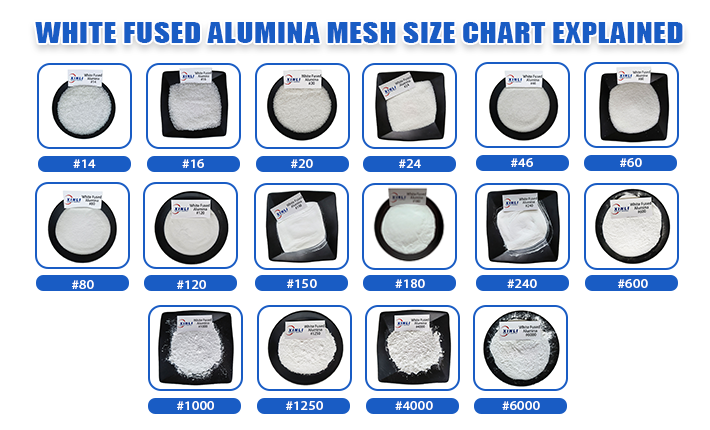
| 200 mesh / 325 mesh | Transition layer or formula filling | Used to improve packing and surface smoothness |
| Custom graded powder | Special membrane design | Selected according to target pore size and sintering curve |
For most ceramic membrane support bodies, buyers should not choose a single particle size only by price. A proper formula often uses a combination of coarse, medium, and fine particles to balance permeability, strength, and dimensional stability.
How Particle Size Affects Ceramic Membrane Performance
Permeability
Coarser WFA particles usually create larger pore channels. This can increase water or gas flow, but if the structure is too open, mechanical strength may decrease.
Mechanical Strength
Finer particles can improve bonding between grains and increase strength, but too many fines may reduce porosity and increase filtration resistance.
Surface Uniformity
A stable transition layer requires finer and more controlled powder. If the particle size distribution is unstable, the surface may become uneven, which affects coating quality of the separation layer.
Sintering Stability
Ultra low sodium WFA with stable grading helps reduce shrinkage variation during firing. This is important for ceramic membrane tubes and plates because dimensional deformation can affect assembly and sealing.
What Ceramic Membrane Buyers Should Check
When purchasing ultra low sodium WFA for ceramic membrane production, buyers should check more than Al2O3 content.
Important points include:
| Check Item | Recommended Focus |
| Na2O content | Confirm low sodium or ultra low sodium grade |
| Particle size distribution | Ask for sieve analysis or laser particle size report |
| Al2O3 purity | Usually high purity is preferred |
| Fe2O3 content | Lower iron is better for clean ceramic products |
| Magnetic material | Important for high-quality ceramic processing |
| Batch consistency | Critical for continuous production |
| Sample testing | Necessary before bulk order |
For ceramic membrane manufacturers, a small change in particle distribution may change the final pore structure. Therefore, stable supply is often more important than the lowest price.
Why Buy from a Factory Supplier
Ceramic membrane production needs long-term material stability. A factory supplier can help control crushing, screening, chemical testing, and batch traceability.
For ceramic membrane buyers, the most important supplier value is not only price. It is whether the supplier can provide the same sodium level, same particle size distribution, and same packing condition for repeated orders.
Before bulk purchase, it is recommended to test samples under real firing conditions and compare shrinkage, pore structure, strength, and filtration performance.
FAQ
What is ultra low sodium WFA used for in ceramic membranes?
It is mainly used in porous ceramic membrane supports and sometimes transition layers where low sodium content and stable particle size are required.
Why is Na2O important for ceramic membrane production?
High Na2O may affect sintering behavior, pore stability, shrinkage, and chemical resistance. Low sodium WFA helps improve process consistency.
What particle size is used for ceramic membrane supports?
Common choices include F60-F100 for main support structure, F120-F220 for finer adjustment, and 200 mesh or 325 mesh powder for transition or formula filling.
Is standard white fused alumina suitable for ceramic membranes?
It may be used in some non-strict applications, but for stable ceramic membrane production, low sodium or ultra low sodium WFA is usually preferred.