
1. What Is White Fused Alumina for Sandblasting?
White fused alumina for sandblasting refers to white fused alumina abrasive media used for surface cleaning, surface roughening, matte finishing and surface preparation. It is also called white aluminum oxide blasting media, white corundum blasting media or WFA blasting media.
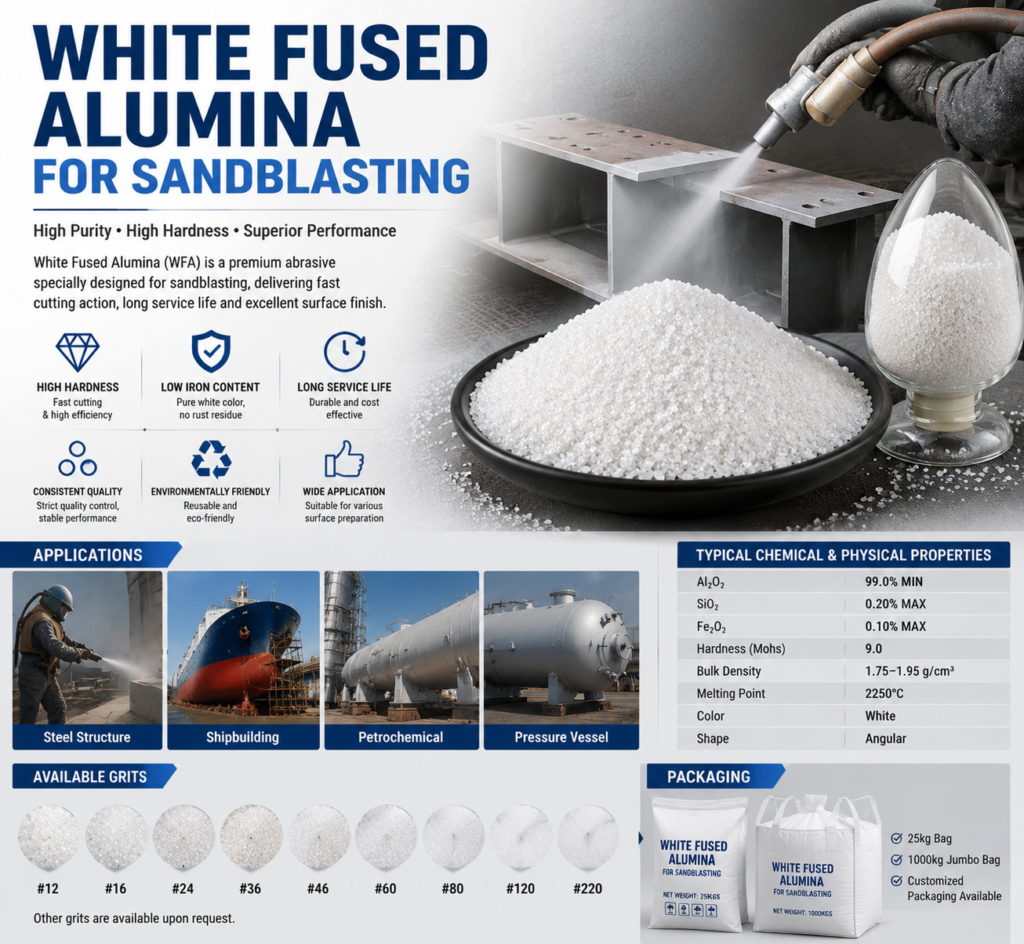
White fused alumina is produced from industrial alumina powder by high-temperature melting in an electric arc furnace. After cooling, crushing, magnetic separation and screening, it is graded into different grit sizes for blasting and other abrasive applications.
In sandblasting, white fused alumina works through high hardness, sharp angular grains and low impurity content. It can clean the surface, create controlled roughness, remove oxide layers, improve coating adhesion or create decorative matte texture.
Compared with ordinary mineral sand, quartz sand or lower-grade blasting media, white fused alumina is more suitable when buyers need clean surface treatment, low contamination risk, stable particle size and controlled surface roughness. It is commonly selected for stainless steel, glass, ceramics, aluminum alloy, molds and precision components.
2. Why Choose White Fused Alumina for Sandblasting?
High Hardness
White fused alumina has high hardness, about Mohs 9. It can effectively impact the workpiece surface and remove oxide layers, light burrs, contamination or old coating.
Clean and Low Impurity
White fused alumina has low iron content and clean white color. It is suitable for stainless steel, glass, ceramics and aluminum alloy surfaces where contamination should be reduced.
Sharp Angular Shape
The angular grains create a clear surface profile. This is useful for coating preparation, bonding preparation and matte surface finishing.
Wide Grit Size Range
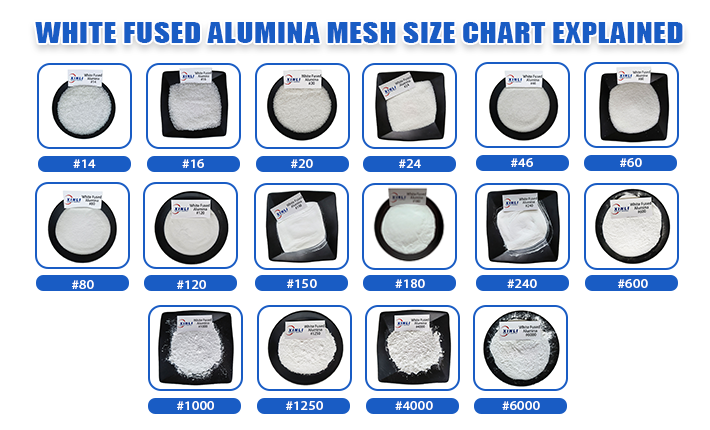
White fused alumina can be supplied in different blasting sizes such as F36, F46, F60, F80, F100, F120, F150, F180 and F220.
Reusable Media
With proper blasting equipment and recovery systems, white fused alumina blasting media can be reused several times. However, after repeated use, the particles become finer and less sharp, so new media should be added regularly.
3. Suitable Workpieces and Applications
Stainless Steel Surface Treatment
White fused alumina is suitable for stainless steel blasting, weld cleaning, matte finishing and coating preparation. Compared with brown fused alumina, it has lower iron contamination risk.
Glass Sandblasting
White fused alumina can be used for frosted glass, logo blasting, glass bottle matte finish, decorative glass and architectural glass surface treatment. Common trial sizes include F80, F100, F120 and F150.
Ceramic and Zirconia Parts
Ceramic surface treatment often requires clean media and stable particle size. White fused alumina can be used for ceramic blasting, surface roughening and bonding preparation.
Aluminum Alloy and Non-Ferrous Metals
White fused alumina can be used for aluminum alloy surface roughening, oxide removal and coating preparation. Grit size should be selected carefully to avoid excessive impact.
Molds and Precision Components
White fused alumina can be used for mold cleaning, surface texture adjustment and light blasting of precision parts. For fine surfaces, finer grit and lower blasting pressure are recommended.
Coating Preparation
White fused alumina blasting can increase surface roughness and improve the adhesion of coatings, adhesives or paint systems.
4. How to Choose Grit Size for Sandblasting
Grit size is one of the most important factors in sandblasting performance. Coarser grit cleans faster and creates higher surface roughness. Finer grit creates a smoother and more delicate surface but works more slowly.
F36-F46:
Suitable for stronger cleaning, roughening, coating preparation and obvious surface texture. It can be used for metal surface roughening, thick oxide removal and aggressive blasting.
F60-F80:
Suitable for general blasting, stainless steel surface treatment, glass frosting, aluminum blasting and general industrial cleaning. This range provides a practical balance between efficiency and surface quality.
F100-F120:
Suitable for fine blasting, glass patterns, logo blasting, glass bottle matte finishing, ceramic surface treatment and light blasting of precision parts.
F150-F180:
Suitable for finer surface treatment, thinner workpieces, fine texture and applications with lower roughness requirement.
F220:
Suitable for light blasting, fine surface adjustment and special low-roughness applications. Processing speed is slower, so testing is recommended.
If the buyer is not sure where to start, F80 and F100 are common trial sizes for stainless steel and glass blasting. F46 and F60 can be tested for stronger roughening. F120 and F150 are better starting points for fine patterns or thinner workpieces.
5. Size Selection by Application
Application: Strong surface roughening
Recommended size: F36-F46
Surface effect: High roughness and fast cleaning
Application: General metal blasting
Recommended size: F60-F80
Surface effect: Balanced roughness and efficiency
Application: Stainless steel matte finish
Recommended size: F80-F120
Surface effect: Uniform surface with lower contamination risk
Application: Glass frosting
Recommended size: F80-F120
Surface effect: Even frosted appearance
Application: Logo and pattern blasting
Recommended size: F100-F150
Surface effect: Better edge control
Application: Ceramic bonding preparation
Recommended size: F100-F180
Surface effect: Fine texture and clean surface
Application: Light blasting of precision parts
Recommended size: F150-F220
Surface effect: Lower impact and finer finish
These sizes are starting references. The final result also depends on blasting pressure, nozzle distance, nozzle angle, blasting time, equipment type and workpiece material. Sample testing is recommended before bulk processing.
6. Dry Blasting vs Wet Blasting
Dry Blasting
Dry blasting is common, efficient and suitable for metal roughening, frosted glass, mold cleaning and industrial surface treatment. However, it produces more dust, so dust collection and worker protection are important.
Wet Blasting
Wet blasting mixes water and abrasive media before impact. It reduces dust and usually creates a softer, more uniform surface. It is suitable for glass products, precision parts, ceramic parts and applications where dust control is important.
If the buyer needs high production efficiency, dry blasting is often selected. If the buyer needs a finer surface and better dust control, wet blasting should be tested.
7. White Fused Alumina vs Other Blasting Media
White Fused Alumina vs Brown Fused Alumina
White fused alumina has higher purity, lower iron content and cleaner color. It is suitable for stainless steel, glass, ceramics and clean surface treatment. Brown fused alumina is tougher and lower cost, making it suitable for ordinary steel and heavy-duty blasting.
White Fused Alumina vs Glass Beads
White fused alumina is angular and cuts more aggressively, creating a stronger surface profile. Glass beads are round and gentler, often used for peening, satin finish and smoother surface effects.
White Fused Alumina vs Quartz Sand
White fused alumina is harder, reusable and more stable in grading. Quartz sand is lower cost, but dust and health risks make it unsuitable for many industrial applications.
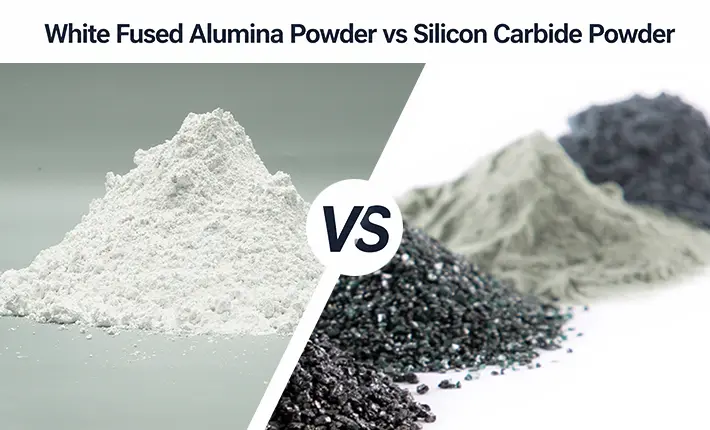
White Fused Alumina vs Silicon Carbide
Silicon carbide is harder and cuts more aggressively. It is suitable for stone, hard materials and high-cutting applications. White fused alumina is better for clean surfaces, glass, stainless steel and general fine blasting.
8. What Buyers Should Check Before Purchase
When buying white fused alumina for sandblasting, buyers should confirm:
1. Grit size: F36, F46, F60, F80, F100, F120, F150, F180, F220 or other size
2. Al2O3 content
3. Fe2O3 content
4. Na2O content
5. Magnetic material
6. Dust content
7. Particle size distribution
8. Particle shape
9. Bulk density
10. Packaging and moisture protection
For stainless steel and glass blasting, Fe2O3, magnetic material and dust content are especially important. For reusable blasting systems, grading stability and grain strength also matter.
9. Common Sandblasting Problems and Solutions
Surface Is Too Rough
The grit may be too coarse, pressure may be too high, or blasting time may be too long. Try a finer size, such as changing from F60 to F100, or reduce pressure.
Uneven Surface
Possible reasons include unstable particle size distribution, inconsistent nozzle movement, pressure fluctuation or insufficient surface cleaning before blasting. Use stable WFA grading and keep a consistent blasting path.
Processing Speed Is Too Slow
The grit may be too fine, pressure may be too low, or recycled media may have become too dull. Test a slightly coarser size, such as changing from F120 to F80.
Too Much Dust
The blasting media may contain too much fine dust, or the media may have been reused too many times. Choose low-dust material and add fresh media regularly.
Pattern Edge Is Not Clear
The problem could be due to coarse abrasive particles, excessive pressure, poor masking film adhesion, or nozzles being too close together. Try using the F100-F150 setting and adjusting the process.
FAQ
Is white fused alumina suitable for sandblasting?
Yes. White fused alumina is hard, sharp and clean. It is commonly used for sandblasting stainless steel, glass, ceramics, aluminum alloy and precision parts.
What grit size is commonly used for white fused alumina sandblasting?
F60-F100 is common for general blasting. F80-F120 is often used for glass frosting. F100-F150 or finer sizes are used for fine blasting and pattern work.
Can white fused alumina blasting media be reused?
Yes. It can be reused in a suitable recovery system, but the particles gradually become finer and less sharp. Fresh media should be added regularly.
What is the difference between white fused alumina and brown fused alumina for blasting?
White fused alumina has higher purity and a lower risk of iron contamination, making it suitable for clean surface treatment. Brown fused alumina is more tough and economical, suitable for sandblasting general steel.
Is white fused alumina good for glass sandblasting?
Yes. F80, F100 and F120 are common trial sizes for frosted glass. F100-F150 can be tested for logos and fine patterns.
123